OK, so last Tuesday, all we did was have our quiz on percent composition, empirical formula and molecular formula.
Then last Thursday, we did Lab 4C- Formula of a Hydrate. This lab was done to determine the percentage of water in an unknown hydrate and to determine the moles of water presnt in this unknown hydrate.
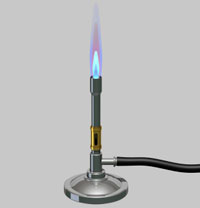
First of all, we heated the crucible with a bunsen burner for a couple of minutes to make sure it was dry.
Then, we let the crucible cool down and weighed the empty crucible. We then added the hyrdate to the crucible and weighed it again. After, we heated the crucible until it was dull red on the bottom and waited for it to cool down and weighed it again. We repeated this step again- the second reading of the mass hydrate should have been within 0.03 grams of the first reading.
Finally, we added a few drops of water into the crucible and observed the changes.
The empirical formula of an organic compound can be found by COMBUSTING the compound (reacting it with oxygen). The mass of the products can then be measured to find how much of each reactant was present. Recall: The Law of Conservation of Mass:the mass of the reactants will always equal the mass of the products!
Let's try an easy example:
A 7.30 gram sample of a hydrocarbon is burned to give 23.8 grams of CO2 and 7.30 grams of H2O. What is the empirical formula?
Notice that all of the C's and all of the H's went into making the carbon dioxide and water!
Step 1: Convert the grams of carbon dioxide and water into moles
Mol CO2 = 23.8g CO2 x (1Mol CO2)/(44.0g CO2)* = 0.541 mol CO2
Empirical formula: is the lowest ratio of atoms/moles in a formula.
Note: All ionic compounds are in its empirical formula
An example would be...
H2F10 is a molecular formula which reduces into HF5 which is the empirical formula!
For example, we were given 58.5% of carbon, 7.3% of hydrogen, and 34.1% nitrogen. What is the empirical formula?
* Assume that there's 100.0g*
1) Convert grams --> moles
C: 58.5 g x 1 mol = 4.88 mol
12.0 g
H: 7.3 g x 1 mol = 7.3 mol
1.0 g
N: 34.1 g x 1 mol= 2.44 mol
14.0g 2) Divide all 3 by smallest molar amount. C: 4.88/2.44= 2 H: 7.3/2.44= 2.99 --> 3(Round it only if it's super close!)
N: 2.44/2.44= 1 Empirical Formula= C2H3N 3) Scale ratios to whole numbers if needed.(For this example, it isn't needed..but if for example you ended up with 1.5, multiple it by 2,3,4,5, etc until you get a whole number.)
Here's a nice little flow chart to show you the steps:
Molecular Formula (MF): multiples of an empirical formula & shows the actual number of atoms that combine to form a molecule. To calculate the MF: n= molar mass of compound molar mass of empirical formula n= a whole number multiple of the empirical mass
So then... MF= N x empirical formula
Ex. A molecule has an empirical formula of HO and a molar mass 51.0 g. What's the molecular formula?
Mass of HO= 17.0 g 51.0 g= 3
17.0g
Using the above formula of MF=N x empirical formula --> 3x(HO)= H303
Ex. A compound contains 8.96 g of Nitrogen and 5.19 g of Oxygen. The molar mass of the compound is 88.0 g. What's the molecular mass?
N: 8.96g x 1 mol = 0.64 mol
14.0g
O: 5.19g x 1 mol =0.32 mol
16.0g
Dividing by the smallest amount:
N: 0.64/0.32= 2 Therefore the empirical formula is N2O.
O: 0.32/0.32= 1
Then using the molecular formula:
Molar mass of N2O= 44.0 g/mol 88.0 g/mol= 2 MF= 2 x N20= N402
44.0 g/mol Note: When writing down the molecular formula, if it doesn't form an ionic compound, write it alphabetically.
Time for some random chemistry jokes? Kekekeeke. Q: What is the chemical formula for the molecules in candy? A: Carbon-Holmium-Cobalt-Lanthanum-Tellurium or CHoCoLaTe Ooooh..trickytricky. ;P Q: What does a teary-eyed, joyful Santa say about chemistry? A: HOH, HOH, HOH! Q: What did the bartender say when oxygen, hydrogen, sulfur, sodium, and phosphorous walked into his bar? A: OH SNaP!
So what did we learn today? That's right! Percent Composition!!!
Percent Composition is the mass percentage of a element in a molecule.
To calculate percent composition it's as easy as 1 2 3! There's no formula to memorize... you wanna know the secret to it?
There's no secret! In fact you do it all the time to calculate the percent for your marks. But if you do insist a formula here it is: % Composition = mass of element X 100%
mass of compound
Now you know this not so secret formula, let's try it out!
EX 1. Calculate % composition of C2H4O2
Total MM = 60 g/mol (the mass of C2H4O2)
% of C = 24 g/mol X 100 = 40%
60 g/mol
% of H = 4 g/mol X 100% = 6.7%
60 g/mol
% of O = 32 g/mol X 100% = 53.3%
60 g/mol
And that's it! It's that simple! Bet you can't wait to do more of these eh? Well, you're in luck here's a few more examples!
1) Calculate the % composition of FeO.
2) Calculate the % composition of H2O
3)Calculate the % composition of Co(NO3)2
4)What is the % composition of the underlined portion of this compound C8H9NO2
5) A compound has a mass of 51.2 g. It contains 20g of O, 19.2 g of S and a mystery amount of N. What is the % composition of N?
On Thursday's class, we had a substitute. First, he gave us the answers to the mole conversion worksheet. Then, he gave us a couple of minutes to review before writing our mole conversions quiz. After the quiz, we worked on two mole worksheets until class ended.
So lets hear some jokes, shall we?
Q:What did Avogadro teach his students in math class?
A: MOLE-tiplication!
Q: What was Avogadro's favorite Indian tribe?
A: The MOLE-hawks
Q: Why did Avogadro stop going to the chiropractor on October 24th?
A: Cause he was only tense to the 23rd!
Q: How does Avogadro write to his friends?
A: By E-mole!
Q: Which tooth did Avogadro have pulled out?
A: One of his molars!
As mole conversions get more and more complex, remember to draw a MOLE MAP!
This is a perfect example of a mind map to use.
To get from...
Grams to moles - multiply by 1mole/MMg (molar mass in grams)
Moles to molecules - multiply by 6.022 x 10^23/1mole
Molecules to particular kind of atoms in a particle (not present in this mind map) - multiply by number of the specific atom/1molecule
Particular kind of atoms in a particle to molecule - multiply by 1molecule/number of the specific atom
Molecules to moles - multiply by 1mole/6.022 x 10^23
Moles to grams - multiply by MMg/1mole
FUN FACTS!
1)6.022 x 10^23 Watermelon Seeds would be found inside a melon slightly larger than the moon!
2) Mole Day is an unofficial holiday celebrated among chemists in North America on October 23, between 6:02 AM and 6:02 PM.
3) There are 3 types of moles that live underground in North America: Eastern Mole, Hairy-Tailed Mole and Star-Nosed Mole.
DID YOU KNOW?
There is a lunar crater called Avogadro - named after this fine looking lad!
Last time we learned about molar mass, so now it's time to use it in conversions. Remember: Avogrado's number = 6.022 x 10^23 particles/mol Remember: Put answers in the correct number of sigfigs.
1) Converting between particles <--> moles. In this conversion, we use Avogrado's number.
a) Particles --> moles
# of particles x 1 mol = # of moles
6.022x10^23particles
Ex. If there are 3.01 x 10^24 C particles, how many moles are there?
3.01 x 10^24 C particles x 1 mol = 5.00 moles of C
6.022 x 10^23 particles
b) Moles --> particles
Another example:
If there are 0.75 mole of CO2, how many molecules are there?
0.75 moles CO2 x 6.022 x 10^23 particles = 4.5 x 10^23 molecules of CO2
1 mole
Now that you know how many molecules are in CO2, how many atoms of Oxygen are there?
4.5 x 10^23 molecules CO2 x 2 atoms of Oxygen = 9.0 x 10^23 atoms of O
1 molecule of CO2
2) Converting between moles <--> grams. Remember in this type of conversion we use the molar mass.
a) Moles--> grams
# of moles x molar mass = # of grams
1 mole
Note: To find the molar mass, look at the periodic table for the atomic mass.
Ex. If there are 2.04 moles of Carbon, what is the mass?
2.04 moles x 12.0 g = 24.5 g of Carbon
1 mole
b) Grams --> moles
# of grams x 1 mole = # of moles
molar mass
Ex. If there is 3.45 g of Carbon, how man moles are present?
3.45 g x 1 mole = 0.288 mole of Carbon
12.0 g
Another example: If there are 6.2 g of MgCl2, how many moles are present?
6.2 g x 1 mole = 0.065 mole of Mg Cl2
95.3 g
Whewww, that's a lot of info..time for a chem joke!
 First of all, we heated the crucible with a bunsen burner for a couple of minutes to make sure it was dry.


